Why one sound is rarely enough: how to mix your own sleep sounds
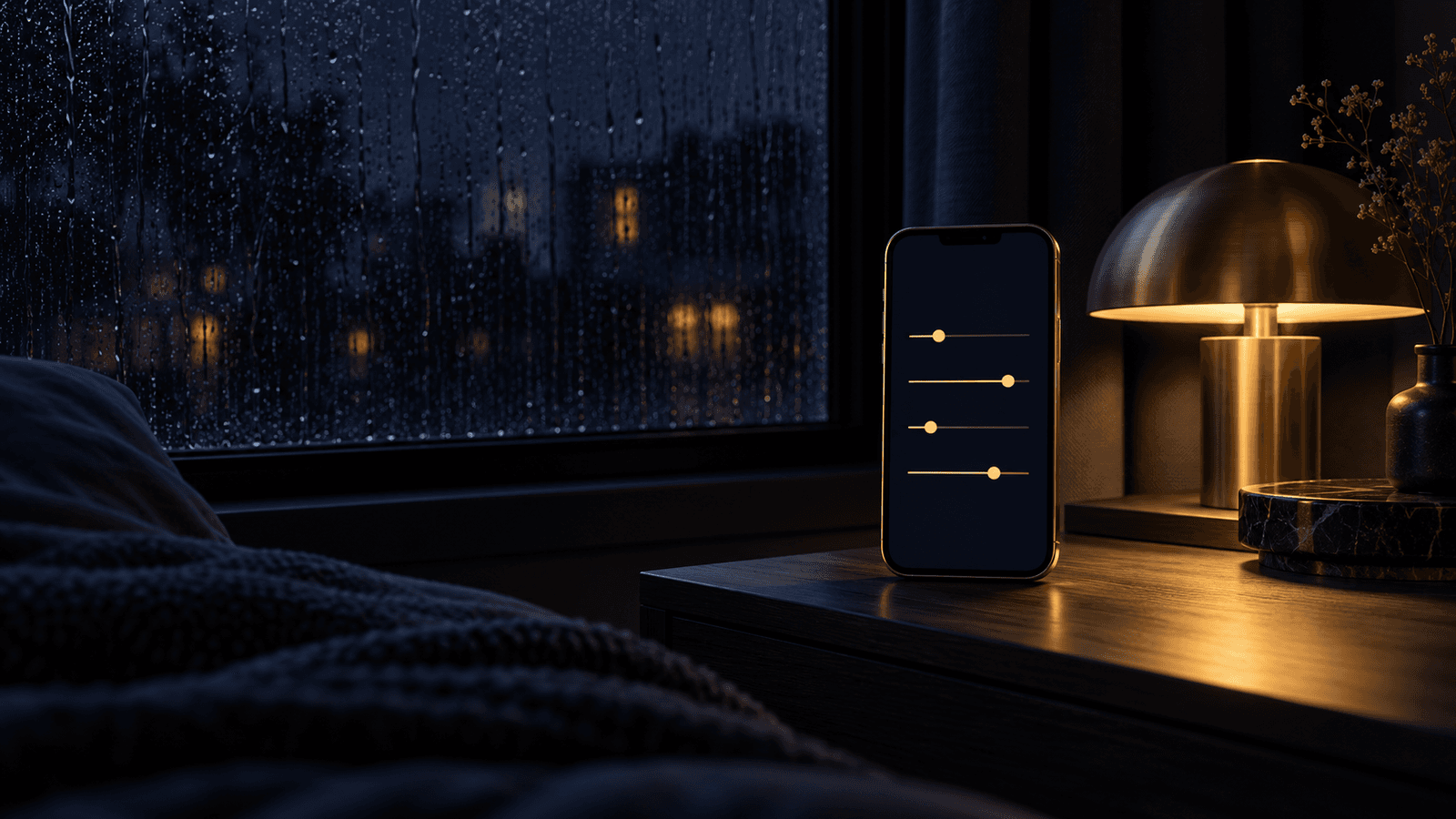
Most people start with one sound. Rain, or a fan, or ocean waves, picked because it sounded calming in a video once. Then a car alarm cuts through it, or a neighbor’s door, and the one sound didn’t do its job. The usual response is to turn it up. Often the better fix is to add a second sound, not more volume.
Why one sound often isn’t enough
A single sound only covers part of the noise your room needs masked. Rain is mostly a mid- and high-frequency hiss, good at covering voices, footsteps, a dripping tap. It does very little in the low end. A low hum covers that lower range instead: traffic, a neighbor’s bass, the building settling. Played alone, either one leaves a gap. Played together, at modest volumes, they cover more of the range that was interrupting you in the first place.
This is the whole logic behind a sound mixer instead of a sound picker. You’re not choosing a favorite. You’re covering more ground with less of any one thing.
What to layer, and why
A few combinations come up again and again, because they solve different problems at once. These three can all be built with DreamTide’s free sounds:
- Rain on a Window + Ac Vent Whispers. The rain handles the high end; the vent hum fills in underneath. It’s a good starting pair for a room with traffic or building noise. If you want the low layer deeper, try Basement Dehumidifier Hum in its place.
- Fireplace + Alpine Meadow Breeze. The fire gives you a soft, irregular crackle that’s easier to tune out than something perfectly steady. A gentle breeze underneath smooths the gaps between crackles.
- Night Crickets + Rain on a Window. Good for someone who finds pure white or brown noise a little harsh, but still wants more than a single quiet layer.
If you have Premium, the wider library opens more pairs. Rain with a Room Fan (Premium) is a classic: the same high-and-low logic, with a fan’s steadier low end.
None of these need to be loud. Two sounds at modest levels can feel fuller than one turned all the way up, and they’re gentler on the ears over a full night.
How to set the levels
There’s no single correct ratio, but a reasonable place to start is uneven, not equal. Pick one sound as the base, something steady like rain, and bring it to a level where you can hear it clearly but it’s not harsh. Then add the second sound underneath it, quieter, just enough to fill in what the first one misses. If you can consciously pick out the second sound on its own, it’s probably louder than it needs to be. It should blend in, not announce itself.
From there, adjust by ear over a few nights. The right mix is the one that makes the room feel quieter overall, not the one that sounds best for thirty seconds while you’re still awake deciding.
In DreamTide’s Mixer, each sound you add gets its own slider, and there’s a master volume on top of all of them, so you can set the balance between layers once and then move the whole mix up or down without re-balancing every time. On the free plan the Mixer opens empty. Add your first sound from the free list and build from there.
Add a timer that matches your night
A mix that plays all night isn’t always what you want. If you fall asleep quickly most nights, a shorter timer that fades out rather than cutting off can be enough. The fade matters more than the exact number, since an abrupt stop can be as noticeable as an abrupt sound.
DreamTide’s free timer runs up to 1 hour, which suits nights when sleep comes quickly. Longer timers, up to 12 hours, are part of Premium. If you wake at 3am and need the room covered again until morning, a longer timer does that without you having to reach for your phone in the dark to restart anything.
Save it once you find it
Once a mix is working, the easiest mistake is forgetting what was in it. Tap “Save this mix” and DreamTide keeps it under the names of its first two sounds, so “Rain on a Window · Ac Vent Whispers” waits in your Library under Mixes, ready to open instead of a layer-by-layer rebuild every night.
Give the mix less to do
None of this matters much if the twenty minutes before you put the sound on are still bright screens and a racing to-do list. A mix can cover noise. It can’t undo a mind that’s still at full speed. Give yourself a few quiet minutes, lights down and phone down, before the sound goes on, and the mix will have less work to do.
If you’re still deciding between one sound and several, Rain sounds or sleep stories: which should you try tonight? and How to use a sleep timer for bedtime audio cover the two pieces this post builds on.
Common questions
Do I need more than two sounds?
Not usually. Two sounds that cover different ranges, one higher and one lower, are a good place to start. Add a third only if something still gets through, since more layers can start to compete rather than cover for each other.
Should the sounds be the same volume?
No. Pick one as the base at a comfortable level, then bring the second one in underneath it, quieter. Equal volumes tend to make both sounds more noticeable, which works against the point of masking.
Is a loud mix better at blocking noise than a quiet one?
Not necessarily, and it’s harder on your ears over a full night. A second sound at a modest level is often gentler than raising one sound’s volume.
What if the room is already pretty quiet?
Then a single, quieter sound is often enough, and a short timer with a fade-out is more useful than layering. Mixing is most useful when there’s a specific noise, like traffic, a snoring partner or a noisy building, that one sound alone doesn’t fully cover.
Make room for a softer wind-down
DreamTide is a small, sleep-first app: slow stories, gentle wind-downs, and a layered sound mixer, narrated in soft, real voices, with timers that fade to silence once you’re asleep. 32 soundscapes and stories are free to use without subscribing. A 7-day introductory offer may be available to eligible new subscribers; the offer shown in your app store before purchase controls.